

It’s been interesting to watch how public opinion on AI evolves.
I remember when an early-stage image generator broke out years ago (I can’t remember which); virtual queues to test it were long, and people mostly generated bizarre memes that never seemed to go much further than a viral Twitter or Reddit post. It was novel.
Early AI videos looked horrifying. Remember Will Smith eating spaghetti?
Then OpenAI dropped ChatGPT, and people seemed pretty amazed. Over time, the technology improved, became widely available and thus encroached on all kinds of tools, apps and workflows. It’s been a welcome change for some, but not so much for others.
Since generative AI’s widespread debut, we’ve had plenty of time to interact with the technology, learn more about how it works, pick apart its strengths and weaknesses, and consider its cost-benefit ratio as it relates to actual pricing, the environment, society, art, culture and more.
We asked respondents to our latest AI Adoption in Marketing Teams survey how they feel about the future and their outlook on AI in marketing. Their takes span the spectrum. Here’s what they had to say.

Breaking Down Marketers’ AI Outlooks
This year’s survey reached 163 marketers, 143 of whom opted to share their outlook on the future of AI in marketing.
We grouped respondents into eight categories based on how they feel the future of AI will ultimately unfold:
- Incremental or gradual growth (58.7%).
- Cautiously optimistic (12.6%).
- AI as a support for marketers, not a replacement (11.2%).
- Strongly optimistic (5.6%).
- Efficiency and automation focus (4.9%).
- Uncertain or “Wait and see” (1.4%).
- Governance, risk and trust concerns (0.7%).
- Skeptical or limited adoption (0.7%).
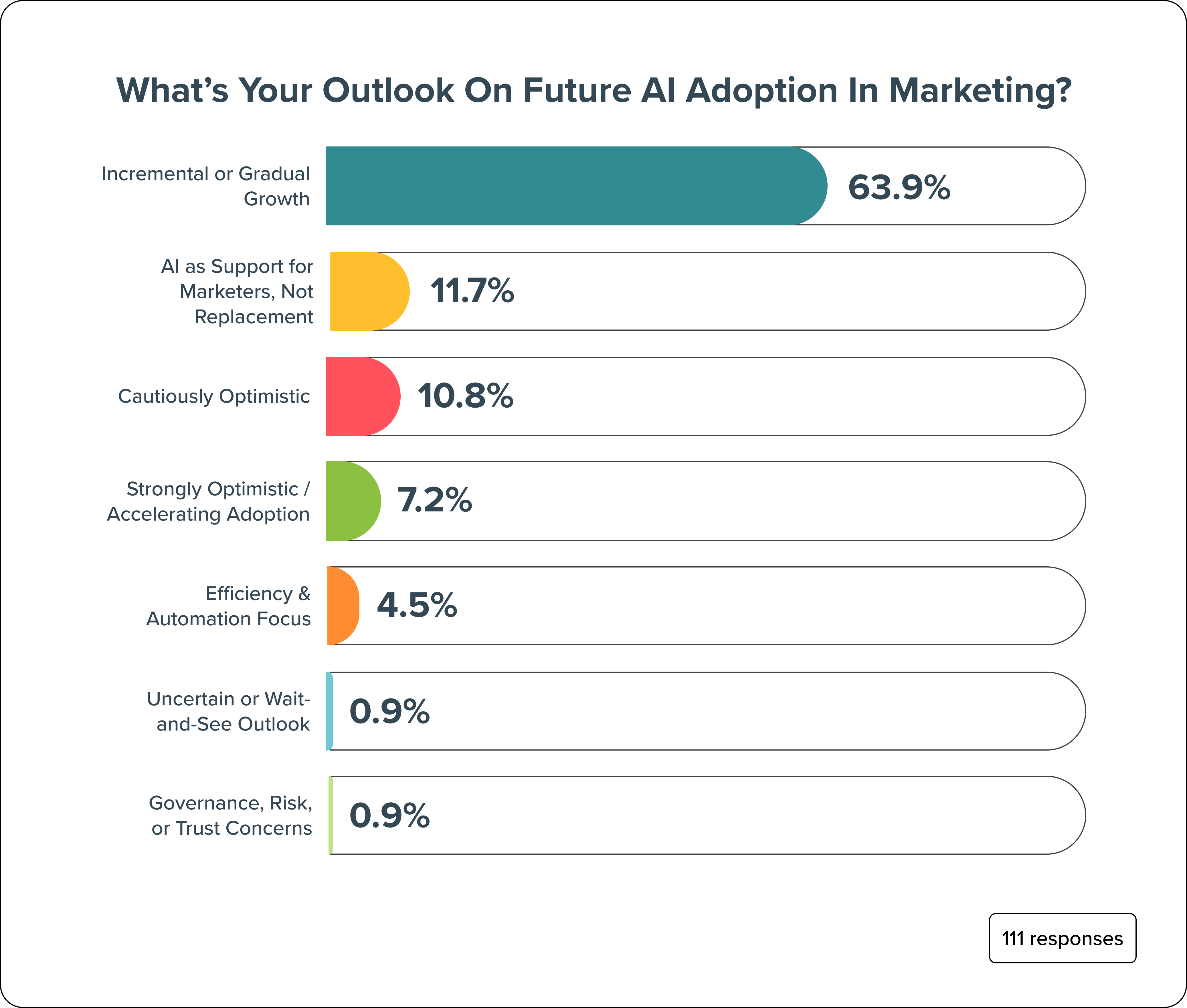
Since these categories mix different attitudes, expectations and themes, I grouped respondents into more identifiable categories below based on the sentiment conveyed in their written responses.
Most Marketers Believe AI Adoption & Growth is Inevitable
A vast majority of respondents (58.7%) predict that AI adoption and its role in marketing will continue to grow gradually over time. But both within this group and our sample at large, there’s assorted sentiment, even if most believe AI is here to stay.
To get a clearer picture, let’s organize overall sentiment into four buckets:
- “Yes, but…”: This is most respondents. ~60–65% of marketers generally want to embrace AI, but with clear limits and human oversight.
- “Bring it on”: ~20–25% of marketers shared clear enthusiasm for AI and are excited for what the future holds.
- “Like it or not”: These marketers, who make up ~10–15%, believe adoption is likely inevitable but worry about its personal, professional or environmental impacts.
- “Still deciding/unclear”: ~2–5% of marketers are still unsure how they feel or where they believe AI will end up.
Overall, responses suggest that marketers are no longer debating whether AI will remain part of their work, but rather, what role it should play.
Even among enthusiastic adopters, many stressed the importance of human judgment, creativity and quality control. The dominant outlook is not unrestricted adoption, but human-led adoption.
Let’s take a closer look at each group.
Yes, But… (~60–65%)
Most marketers see AI becoming a permanent fixture of marketing, but only if paired with human expertise, creativity and oversight.
These folks do not see AI replacing human marketers entirely; rather, they expect it to handle repetitive work while people remain responsible for strategy, judgment and creative thinking.
That balance came through repeatedly in responses.
One marketer said, “We focus on using AI for analysis rather than on creativity. We want to keep the humans for creative functions.”
Another wrote, “It has its uses for streamlining and time saving but should never be used to replace creatives.”
Others echoed similar themes, describing AI as “a soundboard for planning and research” or saying, “AI Agents are great assistants… But we cannot expect brilliant creative power.”
Bring It On (~20–25%)
A decent chunk of respondents are enthusiastic about AI’s future in marketing, viewing it not just as another tool but as an opportunity to work differently.
Many respondents described AI as something they plan to expand into more areas of their work, particularly research, planning, data analysis and workflow automation.
One respondent called AI an “absolute necessity,” while another described it simply as having “huge potential.”
Some were even unequivocal in their optimism and already looking ahead to broader adoption, with one respondent saying, “We are optimistic! We would love to see more AI professional development opportunities […] that will help us continue to improve efficiency, communications, and ROI. We are a small team, and AI has helped us reach many goals!”
Like It or Not (~10–15%)
Of course, not everyone welcomes AI’s growing prominence in marketing or in general. While these respondents generally acknowledged that adoption will most likely continue, they expressed concerns about the quality of AI-generated content, environmental impact, overreliance and what widespread adoption could mean for the industry.
One marketer wrote, “Personally, I hate it and I think it cheapens the point of communication,” adding, “I don’t think the benefits outweigh the cost.”
Another warned that the internet will increasingly become “AI workslop until most people develop a distaste for any content that sounds remotely AI-aided.”
Another marketer, though they believe AI to be “very dangerous,” is still interested in how AI can apply to content creation, noting, “I think in 2026, I’ll be using it [AI] only for brainstorming and spellchecking, which are things that LLMs are actually useful for.”
Still Deciding/Unclear (~2–5%)
A small group of respondents didn’t take a firm position either way.
Their responses reflected uncertainty, with comments like “[AI’s value] remains to be seen” or simply “Unsure.” Rather than expressing clear-cut enthusiasm or concern, these marketers appear to be taking a wait-and-see stance.
Subscribe to
The Content Marketer
Get weekly insights, advice and opinions about all things digital marketing.
Thanks for subscribing! Keep an eye out for a Welcome email from us shortly. If you don’t see it come through, check your spam folder and mark the email as “not spam.”
What Marketers Welcome & Fear
In general, respondents seemed most comfortable using AI for behind-the-scenes work: automation, analysis, research and early-stage ideation.
As AI use moves closer to a finished deliverable, resistance seems to grow, especially in thought leadership, writing, design, video and customer-facing communication.
What Marketers Want AI To Do
Across our responses, some of the most mentioned and welcome AI applications include:
- Automating manual processes.
- Supporting research and analysis.
- Organizing ideas and creating outlines.
- Improving personalization, reporting and data analysis.
One respondent noted, “I think AI adoption in marketing will be necessary to keep up in terms of data analysis, reporting, and outlining ideas and campaigns,” adding, “The point of AI is not to increase production across the board. It’s to provide humans more time to do the thing that AI can not — think creatively.”
Another noted, “I think it’s an unnecessary evil and should only be used for data analysis, not for any kind of content creation (written or visual).”
What They Don’t Want AI To Replace
The strongest lines in the sand involved limiting how AI interacts with:
- Original creative thinking.
- Authentic voice and brand personality.
- Fact-checking and quality assurance.
One marketer, who happens to be strongly optimistic about the future of AI in marketing, offers their perspective on how marketers ought to use the technology: “People right now are thinking, ‘Did they do that with AI?’ as a way to gauge authenticity and value. You have an issue of looking like someone taking a shortcut instead of being thoughtful and intentional. That’s the danger.”
They continued, “The expectations of the receiver/audience will change, as will the capabilities of the tech. The departments that use AI to accelerate THEIR messaging instead of simply using it to replace the identity of their organization likely will find the most success.”
One particularly self-aware, cautiously optimistic respondent is concerned their interest in AI could lead to the degradation of their own writing style and voice: “I want to learn more. I really enjoy the creativity it [AI] helps me unlock but am also nervous about losing my voice or style.”
Final Thoughts
Marketers may disagree about whether AI’s continued growth is exciting, troubling or simply unavoidable, but there is broad agreement on one point: It will most certainly remain part of marketing and even grow more involved yet.
The “debate” this time around was less about whether marketers should use AI and more about how they can use it without sacrificing the qualities both themselves and audiences value most: originality, accuracy and human connection.
Even the most optimistic respondents rarely described a future in which AI operates entirely on its own. Instead, they envision it as an increasingly capable assistant that can reduce repetitive work and create new possibilities while marketers remain responsible for finished products.
That makes training, governance and clear organizational expectations increasingly important. The next challenge is ensuring that marketers have the guidance to use AI deliberately rather than simply because it is available.
For a deep-dive on AI policy, training, tools and other topics from this year’s report, explore more entries in this series below:
- AI Policies? What Are Companies Doing in 2026?
- How Marketers Are Learning AI: Most Teams Are Still Figuring It Out as They Go
- The AI Tools Marketers Actually Use — and Why One AI Isn’t Enough Anymore
- AI in Marketing: What Marketers Really Think
- AI in Marketing: How Should Marketers Handle AI Output? Lessons From Our Survey
- AI in Marketing: Who’s Using It?