

AI search is changing what it takes for content to get noticed. Ranking on Google still matters, but marketers have another question to consider: Will an AI-generated answer find and use their content?
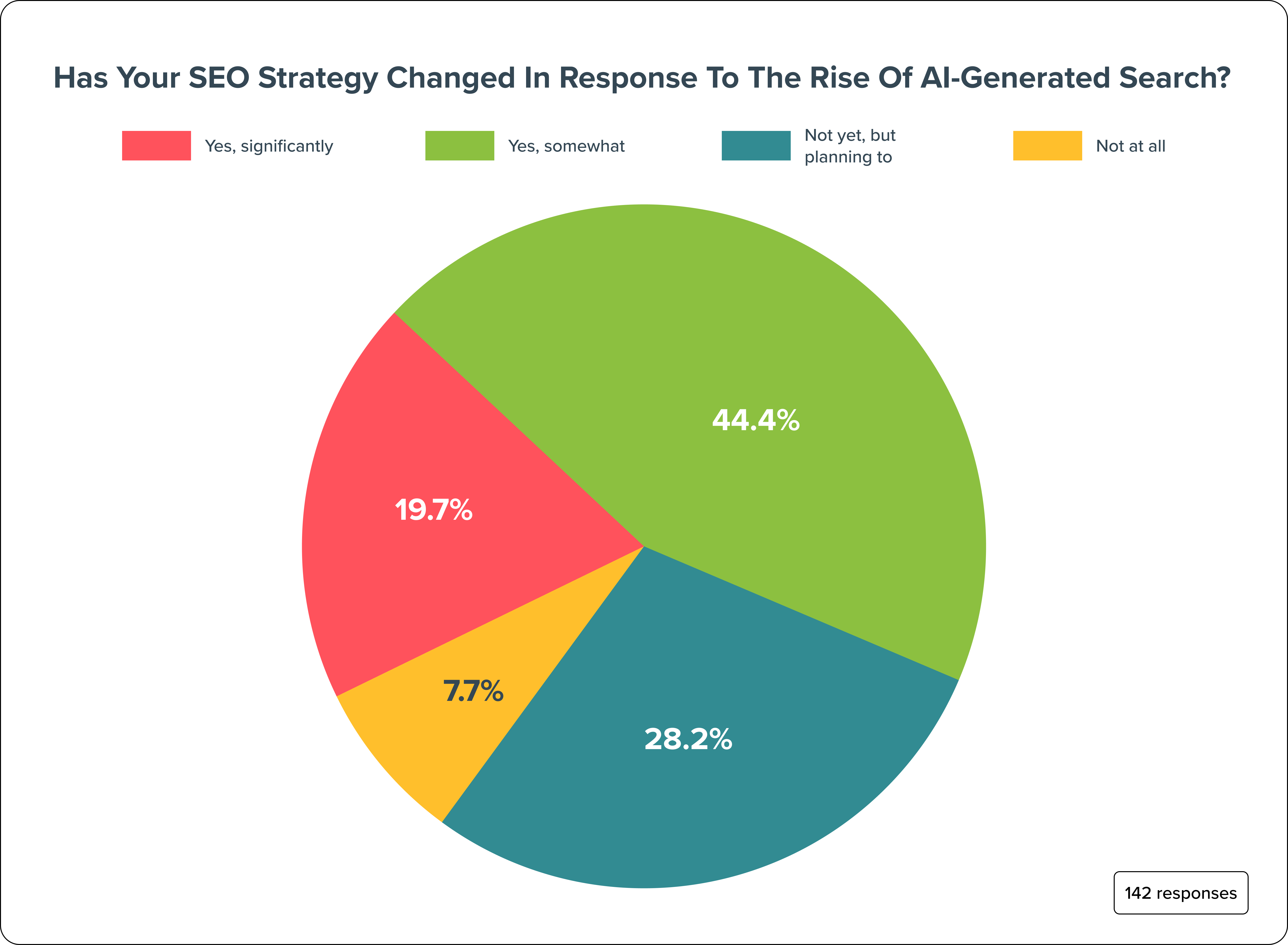
In Brafton’s survey of 142 marketing professionals, 64% said they’d changed their SEO strategy at least somewhat in response to AI-generated search. Some are focusing on technical updates, while others are investing in deeper expertise, more conversational answers and stronger brand authority. But not everyone has made a move yet. Roughly 36% of respondents said they hadn’t changed their SEO strategy.
Whether they’re already adapting or still figuring out where Generative Engine Optimization (GEO) fits, marketers are rethinking what they create, how they create it and what makes content worth publishing.

GEO Is Pushing Content Strategy Beyond “Publish More”
For years, content strategy could revolve around a familiar formula:
- Find the right keywords.
- Check the search volume.
- Publish consistently.
- Cover enough ground to capture demand.
That formula still has value. But generative search adds another question to the mix: Is this content useful, credible and relevant enough for an AI system to surface in an answer?
That shift is changing what marketers prioritize. Instead of simply filling a content calendar, teams are putting more emphasis on depth, expertise, first-hand insights and answers that actually address what their audiences want to know. They’re also thinking more carefully about the signals that establish a brand as a credible source.
At the same time, GEO isn’t asking marketers to abandon SEO. The two strategies overlap in plenty of places, but generative search is raising the bar for what happens after content gets published.
The result is less content for content’s sake and more intention behind what gets created. The keyword still matters. And so does the search volume. But increasingly, marketers have to ask what makes a piece worth finding, reading and, now, citing.
Let’s take a closer look at a few key ways GEO is changing content strategy for marketers:
Subscribe to
The Content Marketer
Get weekly insights, advice and opinions about all things digital marketing.
Thanks for subscribing! Keep an eye out for a Welcome email from us shortly. If you don’t see it come through, check your spam folder and mark the email as “not spam.”
1. Structured Data Is Getting More Intentional
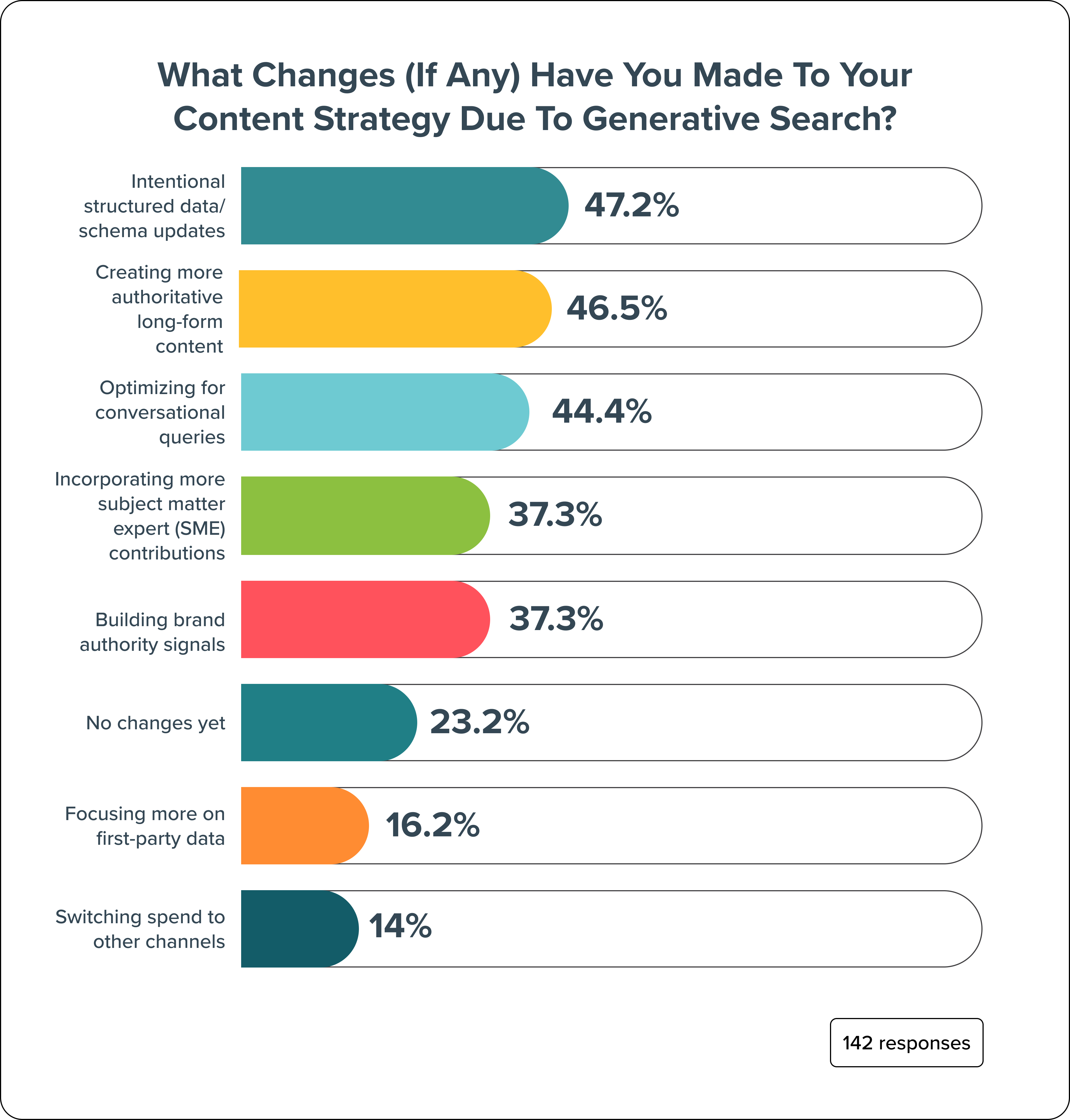
Your content might be brilliant, but search systems still need to figure out what it’s saying. That helps explain why 67 survey respondents said they’ve made intentional structured data or schema updates in response to generative search.
Structured data adds context to a webpage, helping search engines identify information such as products, organizations and articles. In simple terms, it helps machines connect the dots instead of leaving them to guess what a page contains.
That context matters for GEO. Content needs to be accessible and understandable before an AI system can consider using it in a generated answer.
Schema isn’t a shortcut to getting cited, though. Adding markup won’t guarantee that your content appears in ChatGPT or Google’s AI-generated responses. It’s one part of a broader strategy focused on making useful, relevant content easier to find and interpret.
2. Authoritative Long-Form Content Is Having a Moment
Long-form content has been a staple of content marketing for years. GEO is giving marketers another reason to take a closer look at what all those words are actually doing. In fact, 66 respondents said they’re creating more authoritative long-form content because of generative search.
The important word there is authoritative.
Adding another 2,000 words to a topic that’s already been thoroughly covered doesn’t make a piece more valuable. The opportunity is to go deeper with a reason:
- Answer the question thoroughly.
- Add original insights and perspectives.
- Explain nuances that a surface-level answer misses.
- Include evidence, examples and relevant data.
- Bring in genuine industry expertise.
That creates a natural shift away from low-effort content produced simply to capture a keyword or keep the publishing calendar full. Marketers have an opportunity to prioritize content that helps someone understand a complicated topic, evaluate their options or make a decision.
3. Conversational Queries Are Changing How Marketers Write
People don’t always search in neat little keyword phrases. Sometimes, they type a full question, add a few details or keep asking follow-up questions until they get the answer they need. Generative search makes those more natural conversations a bigger part of the content equation.
Brafton’s survey found that 63 respondents are optimizing for conversational queries in response to generative search. For marketers, that means thinking beyond the keyword itself and getting closer to what someone actually wants to know. Here’s a quick example:
- Traditional keyword: “GEO content strategy.”
- Conversational query: “How should I change my content strategy for AI search?”
The second tells you a lot more about what the person is trying to figure out. It gives content teams a clearer starting point for answering the question, addressing related concerns and helping readers work through their options.
That could call for creating content that covers:
- Common questions and follow-ups.
- Comparisons between products, services or approaches.
- Specific use cases and real-world scenarios.
- Practical advice for solving a particular problem.
- The next question someone is likely to ask.
Of course, you don’t have to turn every H2 into a question or awkwardly squeeze conversational phrases into your copy. You just want to understand your audience well enough to create content that speaks to their needs in a natural, useful way.
4. Subject Matter Experts Are Moving Closer to the Keyboard
AI can pull together information from across the web in seconds. So if your content covers the same ground as everyone else’s, what gives someone a reason to pay attention?
One answer: the expertise already inside your business.
Your subject matter experts (SMEs) bring first-hand experience, industry know-how and perspectives that can take a piece beyond the basics. They know the nuances and can share insights that don’t show up in a quick search.
That expertise can make all kinds of content stronger, including:
- Expert interviews and quotes.
- Customer stories and case studies.
- Original research and industry commentary.
- Real-world examples that bring complex topics to life.
And no, bringing SMEs into content creation doesn’t mean asking your busiest expert to become a full-time writer. Start small. Here’s a simple approach:
- Set up a 20-minute conversation.
- Ask questions that draw out their experience and insights.
- Turn the best takeaways into useful content.
That’s it! Your expert brings the know-how; your content team turns it into something readers can actually use. No WordPress training required.
The payoff is content with something real to say. Instead of repeating information readers can find anywhere, your brand can share original perspectives and details grounded in experience. That gives your audience a better reason to trust what you publish, and it gives AI systems more substantive content to draw from when generating answers.
5. Brand Authority Is Becoming Part of the Content Strategy
Publishing great content on your own website is a good start. But GEO gives marketers another reason to look beyond their own domain.
AI systems draw information from across the web, so building brand authority involves more than what you publish yourself. What other sources say about your brand can help establish your credibility, too. That might include:
- Expert authorship: Put knowledgeable people behind your content.
- Industry mentions: Earn recognition from relevant publications and organizations.
- Original research: Share data and insights others can reference.
- Case studies: Show what your expertise looks like in practice.
- Relevant directories: Keep your business information accurate and consistent.
- Social presence: Join conversations that matter to your audience.
The idea isn’t to chase every possible mention or plaster your brand name across the internet. It’s to build a credible presence in the places your audience looks for information.
Think of brand authority as a reputation you build both on and off your website. The more consistently your content demonstrates expertise and your brand shows up in relevant conversations, the more context people have to understand what you do and why they should trust you.
And Then There Are the Marketers Who Haven’t Changed Anything Yet
For some teams, GEO is already on the roadmap. For others, it’s still sitting in the “we should probably figure this out” pile: 51 respondents said they hadn’t changed their SEO strategy yet, either because they were planning changes but hadn’t implemented them or because they hadn’t made changes at all.
That doesn’t necessarily mean they’re ignoring generative search. It could be:
- Knowledge and skills gaps.
- Measurement challenges.
- Resource constraints.
But familiarity seems to make a difference. Every respondent who was familiar with GEO had already made at least some changes to their SEO strategy.
The takeaway is: GEO adoption is happening at different speeds, and knowing what to change might just start with understanding what’s changing in the first place.
What GEO Means for the Next Generation of Content Strategy
GEO isn’t throwing out the content playbook. It’s making marketers rethink what deserves a place in it. The shift is already taking shape in the form of less generic content, in favor of more:
- Original insight.
- Expertise.
- Useful depth.
- Direct answers to the questions audiences actually ask.
Technical optimization still matters, but so does giving people (and AI systems) a compelling reason to pay attention to your brand.
There’s no universal GEO formula yet. Brafton’s survey shows marketers are still working through measurement challenges, resource constraints and which tactics deserve their attention. Some teams are moving ahead; others are still figuring out where to start.
But waiting for every answer isn’t a content strategy. The opportunity is to focus on what your brand can bring to the conversation that others can’t: real expertise, original thinking and content that helps people make informed decisions.
AI can summarize what’s already out there. Give it, and your audience, something worth remembering.